Showing posts with label CCNA 2. Show all posts

Aug 6, 2012

CCNA 2 Chapter 1 V4.0 Answers Updated 2012


1.Which two statements correctly describe the components of a router? (Choose two.) 

RAM permanently stores the configuration file used during the boot sequence.

ROM contains diagnostics executed on hardware modules.

NVRAM stores a backup copy of the IOS used during the boot sequence.

Flash memory does not lose its contents during a reboot.

ROM contains the most current and most complete version of the IOS.

Flash contains boot system commands to identify the location of the IOS.

2.Which interfaces in the exhibit could be used for a leased line WAN connection? (Choose two.) 


1

2

3

4

5

6

3.If a router cannot find a valid configuration file during the startup sequence, what will occur?

The startup sequence will reset.

The router will prompt the user for a response to enter setup mode.

The startup sequence will halt until a valid configuration file is acquired.

The router will generate a default configuration file based on the last valid configuration.

The router will monitor local traffic to determine routing protocol configuration requirements.

4.Which of the following is the correct flow of routines for a router startup? 

load bootstrap, load IOS, apply configuration

load bootstrap, apply configuration, load IOS

load IOS, load bootstrap, apply configuration, check hardware

check hardware, apply configuration, load bootstrap, load IOS

5.What is the default sequence for loading the configuration file? 

NVRAM, FLASH, ROM

FLASH, TFTP,CONSOLE

NVRAM, TFTP, CONSOLE

FLASH, TFTP, ROM

6.From what location can a router load the Cisco IOS during the boot process? (Choose two.) 

RAM

TFTP server

NVRAM

setup routine

Flash memory

terminal

7.Which are functions of a router? (Choose three.) 

packet switching

extension of network segments

segmentation of broadcast domains

selection of best path based on logical addressing

selection of best path based on physical addressing

8.What three processes does a router execute when it receives a packet from one network that is destined for another network? (Choose three.) 

decapsulates the Layer 3 packet by stripping off the Layer 2 frame header

uses the destination MAC Address in the IP Header to look up the next-hop address in the routing table

leaves the Layer 2 frame header intact when decapsulating the Layer 3 packet

uses the destination IP Address in the IP header to look up the next-hop address in the routing table

encapsulates the Layer 3 packet into the new Layer 2 frame and forwards it out the exit interface

encapsulates the Layer 3 packet into a special Layer 1 frame and forwards it to the exit interface

9.The network administrator needs to connect two routers directly via their FastEthernet ports. What cable should the network administrator use?

straight-through

rollover

cross-over

serial

10.Refer to the exhibit.

What can be concluded from the output of the running-configuration of a router? 

The passwords are encrypted.

The current configuration was saved to NVRAM.

The configuration that is shown will be the one used on the next reboot.

The commands that are displayed determine the current operation of the router.

11.Which two statements describe characteristics of load balancing? (Choose two.) 

Load balancing occurs when a router sends the same packet to different destination networks.

Load balancing occurs when the same number of packets are sent over static and dynamic routes.

Load balancing allows a router to forward packets over multiple paths to the same destination network.

Unequal cost load balancing is supported by EIGRP.

If multiple paths with different metrics to a destinations exist, the router cannot support load balancing.

12.Refer to the exhibit. 


What can be concluded from the routing table output in the exhibit? (Choose two.) 

This router only has two interfaces.

The router interfaces are not operational yet.

This router is configured to forward packets to remote networks.

The FastEthernet0/0 and Serial0/0/0 interfaces of this router were configured with an IP address and the no shutdown command.

An IP packet received by this router with a destination address of 198.18.8.2 will be forwarded out of the Serial0/0/0 interface.

13.The serial connection shown in the graphic needs to be configured. Which configuration commands must be made on the Sydney router to establish connectivity with the Melbourne site? (Choose three.) 


Sydney(config-if)# ip address 201.100.53.2 255.255.255.0

Sydney(config-if)# no shutdown

Sydney(config-if)# ip address 201.100.53.1 255.255.255.224

Sydney(config-if)# clock rate 56000

Sydney(config-if)# ip host Melbourne 201.100.53.2

14.Passwords can be used to restrict access to all or parts of the Cisco IOS. Select the modes and interfaces that can be protected with passwords. (Choose three.) 

VTY interface

console interface

Ethernet interface

secret EXEC mode

privileged EXEC mode

router configuration mode

15.What is the outcome of entering these commands?
R1(config)# line vty 0 4 
R1(config-line)# password check123 
R1(config-line)# login 

ensures that a password is entered before entering user EXEC mode

sets the password to be used for connecting to this router via Telnet

requires check123 to be entered before the configuration can be saved

creates a local user account for logging in to a router or switch


16.Refer to the exhibit.

The network administrator has configured the router with the interface IP addresses shown for the directly connected networks. Pings from the router to hosts on the connected networks or pings between router interfaces are not working. What is the most likely problem? 

The destination networks do not exist.

The IP addresses on the router interfaces must be configured as network addresses and not host addresses.

The interfaces must be enabled with the no shutdown command.

Each interface must be configured with the clock rate command.

17.A network administrator has just entered new configurations into Router1. Which command should be executed to save configuration changes to NVRAM? 

Router1# copy running-config flash

Router1(config)# copy running-config flash

Router1# copy running-config startup-config

Router1(config)# copy running-config startup-config

Router1# copy startup-config running-config

Router1(config)# copy startup-config running-config


18.Refer to the exhibit. 


All routers have a route in its routing table to each network that is shown in the exhibit. Default routes have not been issued on these routers. What can be concluded about how packets are forwarded in this network? (Choose two.) 

If RouterC receives a packet that is destined for 10.5.1.1, it will be forwarded out interface Fa0/0.

If RouterA receives a packet that is destined for 192.168.3.146, it will be forwarded out interface S0/0/1.

If RouterB receives a packet that is destined for 10.5.27.15, it will be forwarded out interface S0/0/1.

If RouterB receives a packet that is destined for 172.20.255.1, it will be forwarded out interface S0/0/0.

If RouterC receives a packet that is destined for 192.16.5.101, it will be forwarded out interface S0/0/1.


19.What header address information does a router change in the information it receives from an attached Ethernet interface before information is transmitted out another interface? 

only the Layer 2 source address

only the Layer 2 destination address

only the Layer 3 source address

only the Layer 3 destination address

the Layer 2 source and destination address

the Layer 3 source and destination address


20.Refer to the exhibit. 


Host A pings host B. When R4 accepts the ping into the Ethernet interface, what two pieces of header information are included? (Choose two.) 

source IP address: 192.168.10.129

source IP address: BBBB.3333.5677

source MAC address: 5555.AAAA.6666

destination IP address: 192.168.10.33

destination IP address: 192.168.10.134

destination MAC address: 9999.DADC.1234

21.Refer to the exhibit. 


After host 2 is connected to the switch on the LAN, host 2 is unable to communicate with host 1. What is the cause of this problem? 

The subnet mask of host 2 is incorrect.

Host 1 and host 2 are on different networks.

The switch needs an IP address that is not configured.

The router LAN interface and host 1 are on different networks.

The IP address of host 1 is on a different network than is the LAN interface of the router.

Read more »

Jul 18, 2012

CCNA 2 Chapter 11 V4.0 Answers Updated 2012

1.Refer to the exhibit.


What does the "2" stand for in the router ospf 2 statement?

The number 2 is the autonomous system number.

The number 2 indicates the number of networks advertised by OSPF.

The number 2 identifies this particular instance of OSPF on this router.

The number 2 indicates the priority of the OSPF process on this router.

2.Router R1 is participating in the OSPF routing protocol as well as the EIGRP routing protocol.  If R1 learns of network 192.168.10.0/24 from both the OSPF and internal EIGRP routing protocols, how will the route appear in the routing table of R1?

Only the route learned from OSPF will appear in the routing table.

Only the route learned from EIGRP will appear in the routing table.

Both routes will appear in the routing table and they will be used for load balancing.

Neither route will appear in the routing table until the network administrator selects which one to use.

3.Refer to the exhibit. 


What configuration statements would give the results that are shown in the output of the show ip protocolscommand?

B(config)# int fa0/0
B(config-if)# router-id 192.168.1.5

B(config)# int lo0
B(config-if)# ip address 192.168.1.5

B(config)# router ospf 1
B(config-router)# router-id 192.168.1.5

B (config)# router ospf 1
B(config-router)# ip address 192.168.1.5

4.Refer to the exhibit. 


Assuming that the routers have default interface OSPF priorities and no configured loopback interfaces, what two roles will router B play on each network segment? (Choose two.)

DR for network 192.168.1.200

BDR for network 192.168.1.200

DROTHER on 192.168.1.200

DR for network 192.168.1.204

BDR for network 192.168.1.204

DROTHER on network 192.168.1.204

5.A fully converged five router OSPF network has been running successfully for several weeks. All configurations have been saved and no static routes are used. If one router looses power and reboots, what information will be in its routing table after the configuration file is loaded but before OSPF has converged?

All routes for the entire network will be present.

Directly connected networks that are operational will be in the routing table.

Because the SPF algorithm has not completed all calculations, no routes will be in the table.

A summary route for all previously learned routes will automatically appear in the routing table until all LSPs have been received by the router.

6.Refer to the exhibit. 


Routers A, B, C, and D are all running OSPF with default router IDs and OSPF interface priorities. Loopback interfaces are not configured and all interfaces are operational. Router D is the DR and router C is the BDR.

What happens immediately after the following commands are entered on router A?

A(config)# interface fa0/0
A(config-if)# ip ospf priority 255

A will become the DR. D will become the BDR.

A will become the DR. C will remain the BDR.

D will remain the DR. A will become the BDR.

D will remain the DR. C will remain the BDR.

7.Refer to the exhibit. 


Which command sequence on RouterB will redistribute a gateway of last resort to the other routers in OSPF area 0?

RouterB(config)# router ospf 10
RouterB(config-router)# gateway-of-last-resort 172.16.6.6

RouterB(config)# ip route 0.0.0.0 0.0.0.0 serial 0/0/0

RouterB(config)# ip route 0.0.0.0 0.0.0.0 172.16.6.6
RouterB(config)# router ospf 10
RouterB(config-router)# default-information originate

RouterB(config)# router ospf 10
RouterB(config-router)# default-network 172.16.6.6 0.0.0.3 area 0

RouterB(config)# ip route 0.0.0.0 0.0.0.0 172.16.6.6

RouterB(config)# ip default-route 0.0.0.0 0.0.0.0 172.16.6.6
RouterB(config)# router ospf 10
RouterB(config-router)# redistribute ip default-route

8.Refer to the exhibit.

When OSPF is operational in the exhibited network, what neighbor relationship is developed between Router1 and Router2?

A FULL adjacency is formed.

A 2WAY adjacency is formed.

Router2 will become the DR and Router1 will become the BDR.

Both routers will become DROTHERS.

9.Refer to the exhibit.

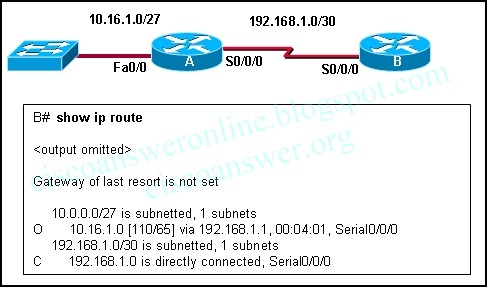
Router A is correctly configured for OSPF. Which OSPF configuration statement or set of statements was entered for router B to generate the exhibited routing table?

B(config-router)# network 192.168.1.0 0.0.0.3 area 0

B(config-router)# network 10.16.1.0 0.0.0.224 area 0

B(config-router)# network 10.16.1.0 255.255.255.224 area 0

B(config-router)# network 192.168.1.0 255.255.255.255 area 0
B(config-router)# network 10.0.0.0 255.255.255.255 area 0

10.What range of networks will be advertised in the OSPF updates by the command Router1(config-router)# network 192.168.0.0 0.0.15.255 area 100?

192.168.0.0/24 through 192.168.0.15/24

192.168.0.0/24 through 192.168.15.0/24

192.168.15.0/24 through 192.168.31.0/24

192.168.15.0/24 through 192.168.255.0/24

192.168.16.0/24 through 192.168.255.0/24

11.Refer to the exhibit. 


The network administrator wants to set the router ID of Router1 to 192.168.100.1. What steps can the administrator take to accomplish this?

shut down the loop back interface

use the OSPF router-id 192.168.100.1 command

use the clear ip ospf process command

nothing, the router-id of Router1 is already 192.168.100.1

12.Refer to the exhibit.

Router1 and Router2 are running OSPF. The show ip ospf neighbor command reveals no neighbors. What is a possible cause?

OSPF autonomous system IDs do not match.

OSPF process IDs do not match.

OSPF network types are identical.

OSPF hello or dead timers do not match.

13.What does OSPF use to calculate the cost to a destination network?

bandwidth

bandwidth and hop count

bandwidth and reliability

bandwidth, load, and reliablity

14.Refer to the exhibit.

What is the cost of the route to the 172.16.2.128 network with the subnet mask of 255.255.255.128?

25

110

196

306

15.Refer to the exhibit.


What does the "O*E2" from the "O*E2 0.0.0.0/0 [110/1] via 192.168.1.1, 00:05:34, Serial0/0/1" line represent?

an internal type 2 OSPF route

an external OSPF route at least two hops away

an external OSPF route from two different sources

an external OSPF route that will not increment in cost

the route was distributed into OSPF from a type 2 router

16.What three parameters must be indentical between OSPF routers in order to form an adjacency? (Choose three.)

area id

K-values

metric value

hello interval

network type

interface type

17.Refer to the exhibit.

All routers have been configured with the interface priorities that are shown. All routers were restarted simultaneously. The results of the DR/BDR election are shown. What can be concluded about this network?

Router C cannot win a DR election under any circumstances.

If the link for interface 192.168.1.4 goes down, router B will become the new DR.

The highest router ID was most likely determined via an OSPF router-id statement or statements.

If a new router is added with a higher router ID than router D, it will become the DR.

18.Which two statements describe the use of OSPF DR/BDR elections? (Choose two.)

Elections are always optional.

Elections are required in all WAN networks.

Elections are required in point-to-point networks.

Elections are required in broadcast multiaccess networks.

Elections are sometimes required in NBMA networks.

19.Refer to the exhibit.

Routers R1, R2, and R3 have four local LANs attached.  What is a correct set of network commands that will cause OSPF to be enabled for any R1 interface that is connected to its subnets?

R1(config-router)# network 10.10.1.0 0.0.3.255 area 0
R1(config-router)# network 172.16.1.0 0.0.0.7 area 0

R1(config-router)# network 10.10.0.0 0.0.255.255 area 0
R1(config-router)# network 172.16.1.0 0.0.0.7 area 0

R1(config-router)# network 10.10.0.0 0.0.3.255 area 0
R1(config-router)# network 172.16.1.0 0.0.0.3 area 0
R1(config-router)# network 172.16.1.8 0.0.0.3 area 0

R1(config-router)# network 10.10.0.0 0.0.0.255 area 0
R1(config-router)# network 10.10.1.0 0.0.0.255 area 0
R1(config-router)# network 10.10.2.0 0.0.0.255 area 0
R1(config-router)# network 10.10.3.0 0.0.0.255 area 0
R1(config-router)# network 172.16.1.0 0.0.0.7 area 0

20.Refer to the exhibit.

What OSPF packets will trigger the reset of the Dead Time counter?

hello packets

link-state update packets

link-state advertisement packets

OSPF routing database update packets

21.Refer to the exhibit. 


All routers are running OSPF. What cost would JAX put in its routing table for the 10.0.0.0/24 network?

2

156

1564

1785

1787

22.Refer to the exhibit. 


How many OSPF adjacencies must be formed to build the complete topology if a DR or BDR were not elected in this OSPF network?

4

5

6

7

10

23.What does OSPF use to reduce the number of exchanges of routing information in networks where large numbers of neighbors are present? (Choose two.)

root router

backup root router

domain router

backup domain router

designated router

backup designated router

24.Refer to the exhibit. 


RouterA, RouterB, and RouterC in the diagram are running OSPF on their Ethernet interfaces. Router D was just added to the network. Routers are configured with the loopback interfaces (Lo 0) that are shown in the exhibit. What happens to the OSPF DR/BDR after RouterD is added to the network?

RouterB takes over as DR and RouterD becomes the BDR.

RouterD becomes the BDR and RouterA remains the DR.

RouterD becomes the DR and RouterA becomes the BDR.

RouterC acts as the DR until the election process is complete.

RouterD becomes the DR and RouterB remains the BDR.

There is no change in the DR or BDR until either current DR or BDR goes down.

25.Refer to the exhibit. 


The routers in the exhibit are using default OSPF configuration settings to advertise all attached networks. If all of the routers start at the same time, what will be the result of the DR and BDR elections for this single area OSPF network? (Choose three.)

HQ will be DR for 10.4.0.0/16.

Router A will be DR for 10.4.0.0/16.

HQ will be BDR for 10.4.0.0/16.

Router A will be DR for 10.5.0.0/16.

Remote will be DR for 10.5.0.0/16.

Remote will be BDR for 10.5.0.0/16.

Read more »

CCNA 2 Chapter 10 V4.0 Answers Updated 2012

1.Refer to the exhibit. 


What does JAX do with link-state packets from ORL?

sends out its updated routing table to both ORL and BOS routers

sends out the individual link-state packets out the interface connected to BOS

queries BOS to see if it has a better route

only adds it to the local routing table and performs no other actions

2.What speeds up convergence in a network using link-state routing?

updates triggered by network changes

updates sent at regular intervals

updates sent only to directly connected neighbors

updates that include complete routing tables

3.What are two advantages of using a link-state routing protocol instead of a distance vector routing protocol? (Choose two.)

The topology database eliminates the need for a routing table.

Each router independently determines the route to each network.

Link-state protocols require less router processor power than distance vector protocols.

After the inital LSP flooding, they generally require less bandwidth to communicate changes in a topology.

Frequent periodic updates are sent to minimize the number of incorrect routes in the topological database.

4.What feature do modern link-state protocols provide to minimize processing and memory requirements?

splitting routing topologies into smaller areas

assigning lower process priorities to route calculations

using update timers to restrict routing updates

strict split horizon rules to reduce routing table entries

5.Refer to the exhibit.

Which statement correctly describes the path traffic would take from the 10.0.0.0/24 network to the 192.168.1.0/24 network if a link-state routing protocol was in use?

BOS -> ATL because this path is the least hops

BOS -> ATL because this path is highest cost

BOS -> ORL -> JAX -> ATL because this path is the lowest cost

traffic would load balance across all links

6.What two events will cause a link state router to send LSPs to all neighbors? (Choose two.)

30 second timer expires

whenever the network topology changes

immediately after the Bellman-Ford algorithm has run

immediately after the DUAL FSM has built the topology database

upon initial startup of router or routing protocol

7.Refer to the exhibit. 


When Router D is configured to use a link-state routing protocol and is added to the network, what is the first thing that it does to begin learning the network topology?

It sends LSP packets to Routers B and C.

It sends LSP packets to all routers in the network.

It sends Hello packets to all routers in the network.

It sends information about its directly connected neighbors to Routers A and E.

It sends information about its directly connected neighbors to all routers in the network.

It learns about its directly connected networks when its interfaces reach the up state.

8.When are link-state packets sent to neighbors?

every 30 seconds

every 180 seconds

after the holddown time expires

when a link goes up or down

when a routing loop occurs

9.What two statements correctly describe the link state routing process? (Choose two.)

all routers in the area have link state databases

each router in the area floods LSPs to all neighbors

LSPs use the reserved multicast address of 224.0.0.10 to reach neighbors

routing loops are prevented by running the Diffusing Update Algorithm (DUAL)

Reliable Transport Protocol (RTP) is the protocol used by for the delivery and reception of LSPs

10.Which database or table must be identical on all link-state routers within an area in order to construct an accurate SPF tree?

routing table

adjacency table

link-state database

neighbor table

topology database

11.A new network administrator is given the task of selecting an appropriate dynamic routing protocol for a software development company. The company has over 100 routers, uses CIDR and VLSM, requires fast convergence, and uses both Cisco and non-Cisco equipment. Which routing protocol is appropriate for this company?

RIP version 2

IGRP

EIGRP

OSPF

BGP

12.Refer to the exhibit.

If all routers and interfaces are configured to use a link-state routing protocol, from which routers will router D receive hello packets?

A and E

B and C

A, B, C, and E

C only

13.What action does a link-state router take immediately upon receipt of an LSP from a neighboring router?

floods the LSP to neighbors

calculates the SPF algorithm

runs the Bellman-Ford algorithm

computes the best path to the destination network

14.Of the steps given, what is the final step in the link state routing process?

successors are placed into the routing table

SPF computes best path to each destination network

LSPs are flooded to all neighbors to converge the network

DUAL algorithm is run to find best path to destination networks

15.Which algorithm is run by link-state routing protocols to calculate the shortest path to destination networks?

DUAL

Dijkstra

Bellman-Ford

Diffie-Hellman

16.To achieve network convergence, what three steps does each link state router take? (Choose three.)

use automatic summarization to reduce the size of routing tables

build a Link State Packet (LSP) containing the state of each directly connected link

flood the LSP to all neighbors, who then store all LSPs received in a database

recalculate the number of hops to each network in the routing table

construct a complete map of the topology and compute the best path to each destination network

use the DUAL FSM to select efficient, loop-free paths, and insert routes into the routing table

17.Why is it difficult for routing loops to occur in networks that use link-state routing?

Each router builds a simple view of the network based on hop count.

Routers flood the network with LSAs to discover routing loops.

Each router builds a complete and synchronized view of the network.

Routers use hold-down timers to prevent routing loops.

18.Which two routing protocols use Dijkstra’s shortest path first algorithm? (Choose two.)

RIPv1

RIPv2

IS-IS

BGP

EIGRP

OSPF

19.Refer to the exhibit.

What kind of information would be seen in an LSP sent from router JAX to router ATL?

hop count

uptime of the route

cost of the link

a list of all the routing protocols in use

Read more »

CCNA 2 Chapter 8 V4.0 Answers Updated 2012

1.Refer to the exhibit. 


What can be determined from this output?

The router will have to perform recursive lookups to forward a packet destined for 192.168.2.213/24.

The parent route for these networks was removed from the routing table.

A route to 192.168.0.0/25 would be classified as a supernet route for the routes listed in the routing table.

All of the routes listed are network routes.

2.Refer to the exhibit. 


A packet destined for host 128.107.0.5/16 is processed by the JAX router. After finding the static route in the routing table that matches the destination network for this packet, what does the router do next?

searches for a default route to forward the packet

drops the packet since the static route does not have an exit interface

performs a recursive lookup to find the exit interface used to forward the packet

sends a request to neighboring routers for the location of the 128.107.0.0 network

3.Refer to the exhibit.

What parent network will automatically be included in the routing table when the three subnets are configured on Router1?

172.16.0.0/16

172.16.0.0/24

172.16.0.0/30

172.16.1.0/16

172.16.1.0/24

4.Refer to the exhibit.


Router B receives a packet with a destination address of 10.16.1.97. What will router B do?

drop the packet

use the default route

forward the packet via the route to 10.16.1.0

forward the packet via the route to 10.16.1.64

5.A route to a destination network is learned from multiple routing protocols. If each learned route has the same network prefix, what is used by a Cisco router to select the preferred route to the destination that will be installed in the routing table?

metric

route prefix

update timer

administrative distance

6.Refer to the exhibit.

Which statement correctly describes this network?

EIGRP is being used

There is at least one parent and one child route

192.168.2.0, 192.168.3.0, and 192.168.4.0 networks are child routes

Traffic going to 172.16.3.0 will be directed to s 0/0/1

7.Refer to the exhibit.

How many routes in this output qualify for use as ultimate routes?

3

4

5

6

7

8

8.Refer to the exhibit. 


With the ip classless command issued, what will router R2 do with a packet destined for host 172.16.4.234?

drop the packet

send packet out Serial 0/0/1

send packet to network 0.0.0.0

send packet out FastEthernet 0/0

9.What determines if the router implements a classless route lookup process?

Child routes are present in the routing table.

The command ip classless is enabled on the router.
A classless routing protocol has been configured on the router.

Routing table entries have a next-hop IP address and an exit interface for each child route.

10.Refer to the exhibit.

Router1 has been issued the ip classless command. What happens to packets destined to host 172.16.3.10?

they are dropped

sent to default gateway

forward out interface Serial0/0/1

forward out interface FastEthernet 0/0


11.Refer to the exhibit. 


What protocol was used to distribute the routing information for the network 172.16.1.4?

RIPv1

RIPv2

EIGRP

OSPF

12.The following entry is displayed in the routing table: 


R 192.168.8.0/24 [120/2] via 192.168.4.1, 00:00:26, Serial0/0/1 


What type of route is this?

a level 1 parent route

a level 1 supernet route

a level 1 ultimate network route

a level 2 child route

a level 2 ultimate child route

13.What occurs when no ip classless is implemented on the router?

The router will only support classful IP addressing.

The router will only support classful routing protocols.

The router will use a default route, if present, when a matching route is not found in the routing table.

The router will assume it has knowledge of all subnets in the network and will not search beyond child routes for a better match.

14.Refer to the exhibit.

The graphic contains partial contents of the routing table on router E. Router E is running version 12.3 of the IOS and is configured for default routing behavior. Router E receives a packet to forward. Which route in the routing table will be searched first and why?

172.16.1.0/25 because it is the first ultimate route

0.0.0.0/0 because it is the lowest network number

172.16.0.0/25 because it is the first level 1 route

172.18.0.0/16 because it has the shortest mask

15.Refer to the exhibit.


 Router1 is running IOS version 12.2. What will the network administrator need to do so that packets for unknown child routes of 172.16.0.0/24 will not be dropped?

issue the ip default-network command

use a classful routing protocol such as RIPv1

enable either OSPF or ISIS as the routing protocol

issue the ip classless command

do nothing, ip classless is on by default

16.Refer to the exhibit.

What subnet mask will Router1 apply to child routes of the 172.16.0.0/24 network?

0.0.0.0

255.255.0.0

255.255.255.0

255.255.255.255

17.Refer to the exhibit. 


The network administrator has discovered that packets destined for servers on the 172.16.254.0 network are being dropped by Router2. What command should the administrator issue to ensure that these packets are sent out the gateway of last resort, Serial 0/0/1?

ip classless

no ip classless

ip default-network 0.0.0.0

ip default-gateway 172.16.254.1

ip route 0.0.0.0 0.0.0.0 Serial 0/0/1

18.A network is converged and the routing tables are complete. When a packet needs to be forwarded, what is the first criterion used to determine the best path in the routing table?

the route with the highest bandwidth

the route with the smallest Administrative Distance

the route with the longest address and mask match to the destination

the route with the best combination of Administrative Distance and lowest cost

Read more »

CCNA 2 Chapter 7 V4.0 Answers Updated 2012

1.What is the maximum network diameter permitted by the default metric of RIPv2?

15 hops

16 hops

100 hops

120 hops

255 hops

2.Refer to the exhibit. 


All routers are running RIPv1. What changes will occur in the routing table of router B if a loopback interface with an address of 10.16.1.129/27 is configured on router B?

Routes to the 10.16.1.0/27, 10.16.1.64/27, and 10.16.1.128/27 networks are added.

A connected route to the 10.16.1.128/27 network is added.

A third route to the 10.0.0.0/8 network with RIPv1 as the source is added.

The 10.0.0.0/8 route is dropped immediately from the routing table after router B is configured.

3.Refer to the exhibit.

RIPv1 is configured as the routing protocol for the network that is shown. The following commands are used on each router:
router rip
network 10.0.0.0
network 172.16.0.0
When this configuration is complete, users on the LAN of each router are unable to access the remote LANs. Why?

The network statements are configured incorrectly.

A routing loop has been created.

RIPv1 is unable to route to discontiguous subnets of a major network.

RIPv1 is unable to route networks with a /24 subnet mask.

4.RIPv2 is the configured routing protocol on the routers in a network. The command Router(config-router)# no version 2 is entered on the routers. What effect does entering this command have on routing updates?

Subnet masks will be added to the routing updates.

Routing updates will be sent out using multicast address 224.0.0.9.

Version 1 and 2 updates will be received and the version 2 updates will not be sent.

The RIP routing process will be removed from the router and routing updates will not be forwarded.

5.Refer to the exhibit. 


Which command will allow Router2 to learn about the 192.168.16.0/28 network?

Router1(config)# ip classless

Router1(config-router)# network 192.168.16.0

Router1(config-router)# no passive-interface serial 0/1/1

Router2(config-router)# version 2

Router2(config-router)# neighbor 10.0.0.2

6.What are two functions of the network command used when configuring routing protocols? (Choose two.)

identifies which networks will be included in the routing updates

identifies the hosts addresses that can be summarized in the network

used to list all addresses for remote and local networks

determines which subnet mask to apply to routing updates

determines which interfaces can send and receive routing updates

7.How are RIP v1 and RIP v2 similar to one another? (Choose three.)

They both use hop count as a metric.

They both have the same metric value for infinite distance.

They both use a broadcast IP address to send updates to their neighbors.

They both send subnet mask information in their updates.

They both provide for authentication of update sources.

They both use split horizon to prevent routing loops.

8.A network administrator installed four new routers that are running RIPv2. Router1 is a boundary router in the RIPv2 network and has a default route configured. Once the network has converged, the network administrator enters Router1(config-router)# default-information originate on Router1. How will this affect the network?

prevents Router1 from forwarding updates about networks that are not directly connected

causes all routers in the network to synchronize routing updates with Router1

forces Router1 to become the primary or designated router (DR) for updates

propagates the default route to all routers in the network

9.Refer to the exhibit.

What effect will the commands that are shown have on RIP updates for Router1?

Only version 2 updates are sent to 255.255.255.255.

Only version 2 updates are sent to 224.0.0.9.

Both version 1 and version 2 updates are sent to 224.0.0.9.

Both version 1 and version 2 updates are sent to 255.255.255.255.

10.What are two reasons to implement RIP version 2 rather than RIP version 1? (Choose two.)

RIP version 2 supports VLSM.

RIP version 2 supports more than 16 routers.

RIP version 2 supports classful (and not classless) routing

RIP version 2 supports routing update authentication.

RIP version 2 supports multi-areas.

RIP version 2 uses the Dijkstra algorithm rather than the Bellman-Ford algorithm.


11.Refer to the exhibit. 


All routers are running RIP version 2. JAX is configured to just advertise the 10.0.0.0/24 network. CHI is configured to advertise the 172.16.0.0/16 network. A network administrator enters the commands shown in the exhibit. What changes will occur in this network?

The JAX router will ignore updates for the 172.16.0.0/16 network due to split horizon issues.

The CHI router will install a route to the 192.168.0.0/16 network in its routing table.

The routing table for CHI will have the 192.168.0.0/16 route but it will have an S next to the route.

The ORL router will apply a 255.255.0.0 subnet mask to all networks in the routing updates it forwards.

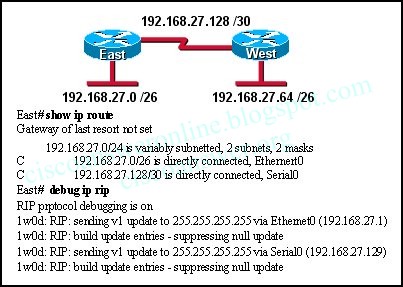
12.Refer to the exhibit.

Routers East and West are configured using RIPv1. Both routers are sending updates about their directly connected routes. The East router can ping the West router serial interface and West can ping the serial interface of East. However, neither router has dynamically learned routes from the other. What is most likely the problem?

A gateway of last resort is required.

Subnetting is not supported by RIPv1.

VLSM is not supported by RIPv1.

One of the routers needs a clock rate on the serial interface.

13.Refer to the exhibit. 


What can be concluded from the output shown in the exhibit?

The routing table is limited to 2 routes.

The LAN interfaces are participating in the routing process.

One update has been sent out of each serial interface and 2 have been received.

The no auto-summary has not been configured on this router.

14.A network administrator has been told that the company IP address infrastructure must adhere to RFC 1918. What three IP address ranges from RFC 1918 could the administrator use on the network? (Choose three.)

10.0.0.0/8

127.0.0.0/8

169.254.0.0/16

172.16.0.0/12

192.168.0.0/16

209.165.201.0/27

15.Refer to the exhibit.

The exhibited network contains a mixture of Cisco and non-Cisco routers. The command debug ip rip was entered on the JAX router. All routers are running the same version of RIP. Router CHI and Router ORL are not able to reach the 192.168.1.16/28 network. What is a possible solution to this problem?

Enable split horizon in the network.

Configure RIPv2 on routers.

Add network 192.168.1.0 to the RIP configuration on the JAX router.

Configure JAX Fa0/0 as a passive interface.

Enable the Serial0/0/0 interface on the JAX router.

Change the IP address on the Fa0/0 interface of the JAX router to 192.168.1.1/24.

16.What field was added to the RIP message header by RFC 1723 to add support for VLSM and CIDR?

subnet mask

destination port number

address family identifier

source and destination IP addresses

17.Refer to the exhibit.

If all routers are running RIP version 2, why is there no route for the 192.168.1.32/27 network?

Rip version 2 does not send subnet masks in its updates.

Router A is not setup with RIP as a routing protocol.

Rip version 2 will auto summarize routes by default.

Router B is not setup to advertise the 192.168.1.64/30 network.

18.Refer to the exhibit.

A technician needs to add a new loopback interface to test routing functionality and network design. The technician enters the following set of commands on the router: 


Sanford(config)# interface loopback1
Sanford(config-if)# ip address 192.168.6.62 255.255.255.252


Why does the router respond with an error?

The router does not allow loopback interface configurations.

This mask can not be used with this class of addresses.

Classless routing must be configured before this address can be added.

The network address for Loopback1 overlaps with an already configured interface address.

The router is over the limit for the maximum paths that can be provided in the routing table.

19.Refer to the exhibit. 


Which command on which router will allow Router1 to learn about the 192.168.0.0/20 network?

Router1(config)# ip classless

Router1(config-router)# no passive-interface serial 0/1/1

Router2(config-router)# version 2

Router2(config-router)# neighbor 10.0.0.2

Read more »